

This item is part of our special edition: “Deciphering Chinese Buddhism”
You can read the previous article in this series by clicking here
The fragmented arrival
Archaeological evidence indicates that, in the first centuries of the Buddhist presence in China, the iconography that arrived in this country was not assimilated in its structural totality, nor did it keep its original patterns intact. Far from acting as mere copyists and replicating foreign models as if they were monolithic blocks, local artisans exercised what we can call “selective appropriation”: instead of transplanting it into its systemic integrity, they adapted and reconfigured foreign imagery —coming mainly from the centers of Gandhara and Mathura, and disseminated through the Silk Road as portable objects—, integrating it into the patterns of their own indigenous art.
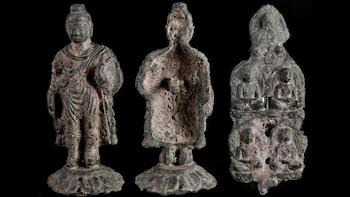
This incipient fragmented and decontextualized assimilation is visible in the oldest vestiges that have come down to us, dated between the end of the 2nd and 3rd century BC. These pieces, almost always found in funerary contexts, do not yet represent a standardized Buddhist iconography, but rather a syncretism with previous beliefs and pre-existing artistic forms.
Funerary Domestication: The Buddha as a Talisman
There are several examples of how Chinese workshops of the time adopted Buddhist images and reconfigured them, turning them into decorative or apotropaic elements —that is, oriented to the protection of the deceased and ritual sponsorship— within their local traditions. For the artisans of the Han dynasty, the image of the Buddha could function as a novel visual instrument to enhance the magical efficacy of tombs.
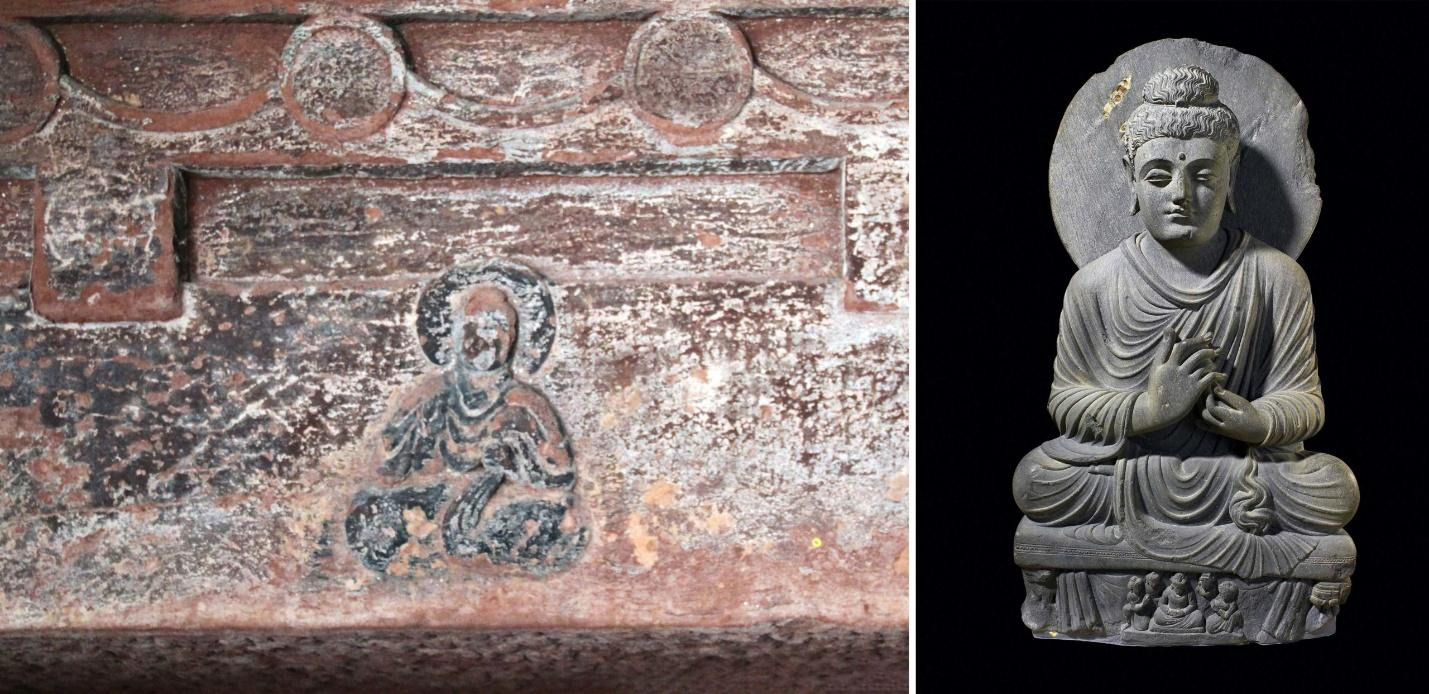
One of the most representative examples of this early Buddhist sculpture is the Mahao lintel Buddha (2nd century BC), found in a tomb in Leshan, in the province of Sichuan. The interesting thing about this piece is how an already recognizable image adapts to the Chinese environment.
Although we recognize the Buddha by his hallmarks — the halo, the ūrṇā (mark between the eyebrows), the Uṣṇīṣa (bun or cranial bump) and the Mudra (the ritual hand gesture) —, the treatment changes: the characteristic realism of Gandhara disappears in favor of a flat and linear relief, in keeping with the decoration of the Han tombs. However, the change is not only visual, but also functional: the figure shifts the devotional emphasis to act as a talisman, another magical guardian, responsible for scaring away evil influences.
Money Trees: The Irony of Wealth
Another outstanding example of this fragmentary and decontextualized artistic appropriation, where Buddhist motifs were inserted into the aesthetics of the local art of the time, is found in the funerary art of Sichuan (ancient kingdom of Shu): “Money Trees” (, Yaoqián Shù). These bronzes radically reinterpreted the figure of the Buddha, fully integrating it into the native visual repertoire.
These sculptures served to seek the eternal prosperity of the deceased in the afterlife. In them, the Buddha appears to be placed under the Queen Mother of the West (Xīwangm) —a closeness probably due to his shared connection with the West—integrating as another foreign god among the beasts, spirits and other deities of Taoist immortality.
Money trees represent the axis that connects earth and sky. Its base, made of glazed ceramic, symbolizes a sacred mountain with auspicious animals such as rams or moon toads. The bronze trunk and branches are decorated with Wu Zhu coins, mythical figures, Taoist immortals and, sometimes, the figure of the Buddha as a symbol of prosperity. At the top, there is the Phoenix or Xīwangm, a deity linked to immortality.
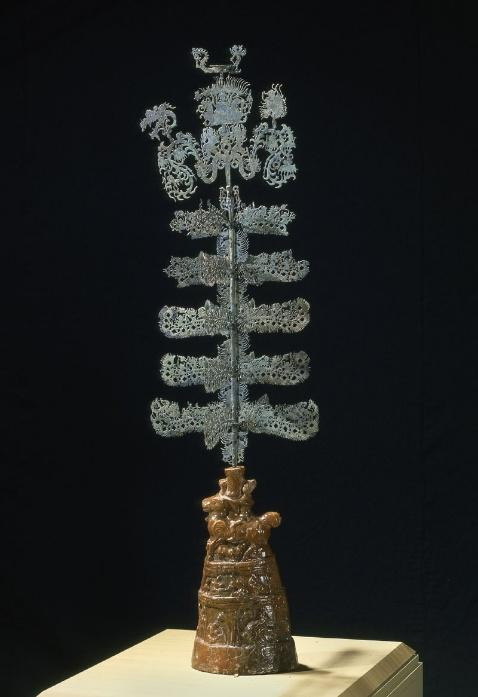

In these pieces from the province of Sichuan, the Buddha appears as if he were just another Taoist immortal. It is paradoxical to find the model of the ascetic par excellence, a symbol of renunciation, surrounded by coins and reinterpreted here as a deity of prosperity: a Chinese god of money. But this, in all likelihood, is not an intentional transgression; the artisans — who were surely unaware of its original meaning — simply recruited a new spiritual power to secure the journey to eternity.
The mirrors of “Deities and Beasts”: sacred geometry
If the “money trees” intended to reach heaven from earth, as a kind of spiritual ladder, the bronze mirrors called Shenshōu Jing (“Mirrors of Deities and Beasts”) they aspired to capture the immensity of the cosmos in the palm of their hand. These discs, which barely exceed twenty centimeters, are not simple playful or decorative objects, but authentic diagrams of the universal order. What makes them truly fascinating is that they represent an important historical crossroads. It is on its surface that, around the second half of the first century A.D., the figure of the Buddha made an appearance stripped of its original context to be “grafted” into traditional Chinese cosmology.
Far from being objects designed for vanity, these mirrors were used as instruments to protect and order the environment: their circular back represented Heaven (Tian), while the central button symbolized the Axis Mundi. It is in this space, surrounded by mythical dragons and tigers, that Buddhism was subjected to this fascinating visual and functional appropriation.
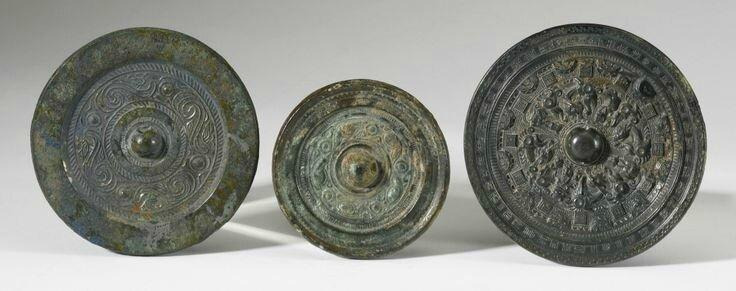
The integration of Buddhism into Shénshōu Jìng mirrors did not respond to an initial philosophical assimilation, but to a structural need in which the figure of the Buddha operated as a functional equivalence within the cosmic order. The iconographic analysis reveals a strategic substitution: in the traditional mythological scheme of the Eastern Hàn dynasty, the Queen Mother of the West (Xīwangm) —the deity of immortality and the axis of the principle Yin— required a male counterpart in the East to preserve the duality of the universe. Although this space traditionally belonged to the Father King of the East (Dōngwánggōng), in several copies of these mirrors the Buddha assumes this position. This reconfiguration suggests that the foreign deity was integrated under the logic of the solar and masculine principles (Yang), acting as an exotic component of great symbolic power that allowed the symmetry of the Han cosmos to be completed without altering its pre-existing mythological architecture.
The Vessels of the Soul
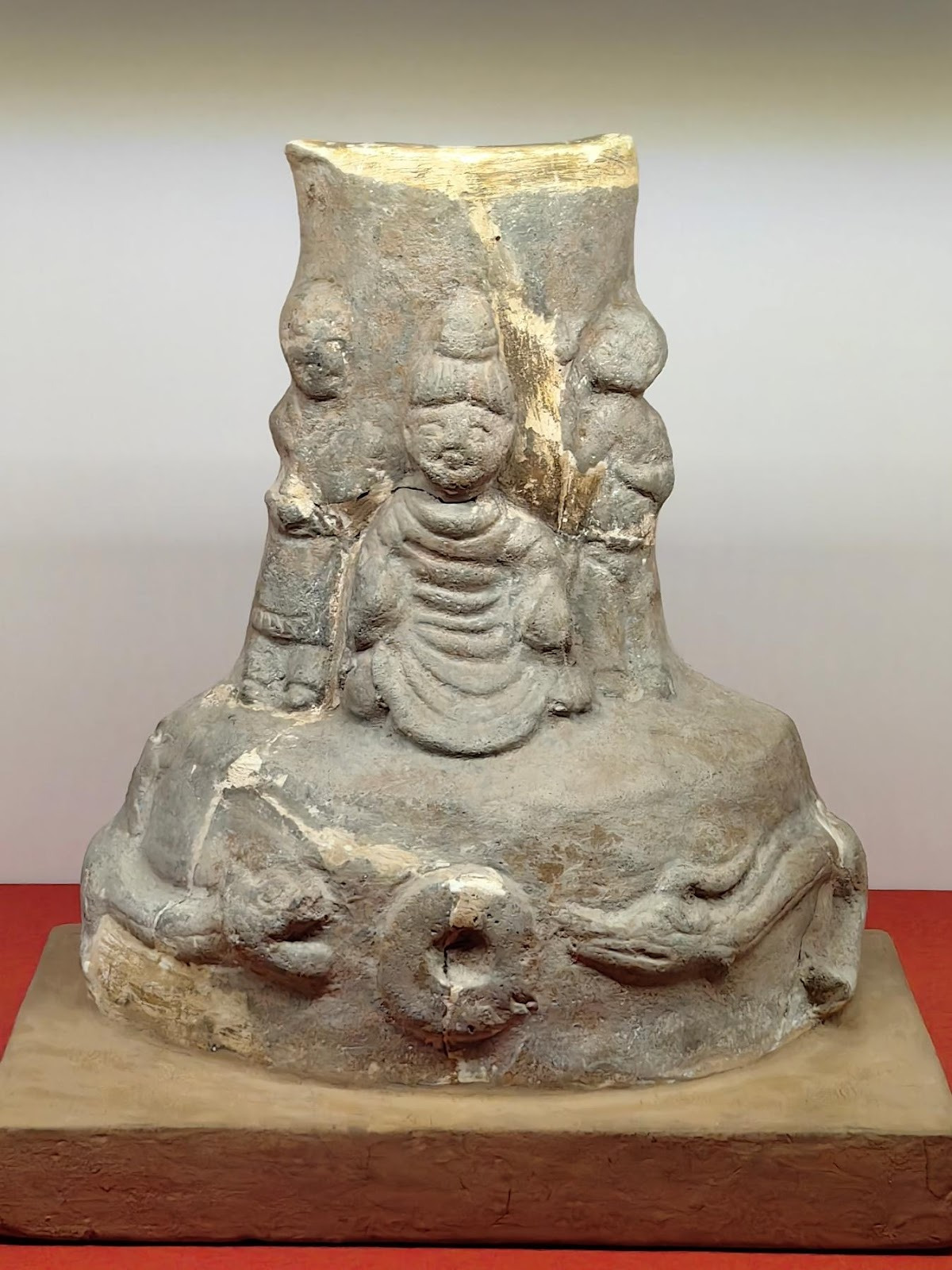
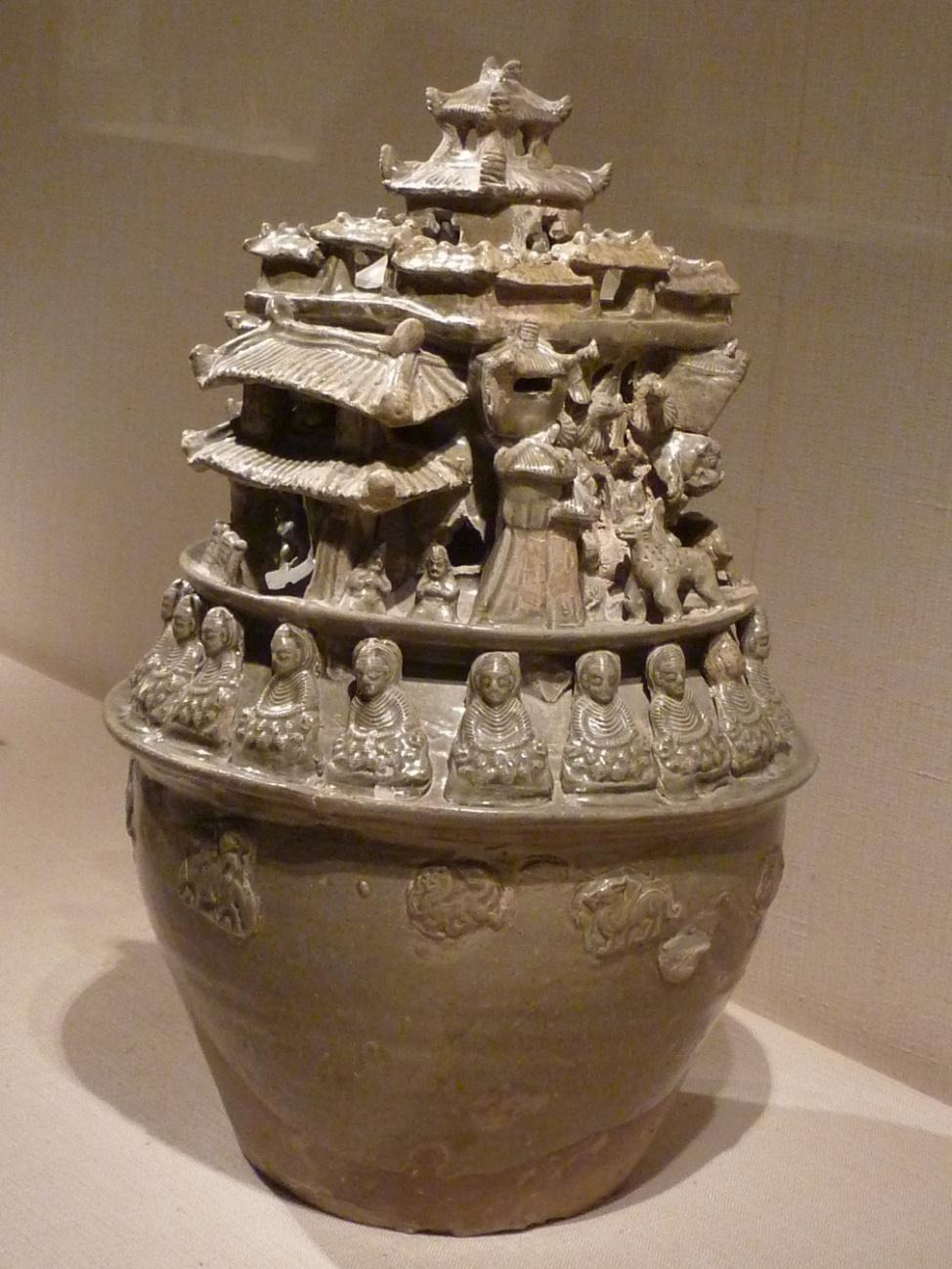
A more illustrative example can be found in southeastern China and more precisely in the kingdom of Wu (3rd century BC), are the “vessels of the soul” (Hungarian Píng). These ceramic urns, designed for the eternal rest of the deceased, show once again the decontextualization of Buddhist iconography. The small figures of the Buddha are embedded in the lid of the container, along with Taoist immortals, birds and mythological beasts in a common landscape. Apart from its devotional centrality, the image of the Buddha is here a decorative resource that has been stripped of all the canonical doctrinal narrative to become one more element in the Chinese imaginary of immortality and abundance postmortem.
The reliefs of Kōngwàngshān: doctrinal confusion
On the cliffs of Liányúngô (Jiāngsū), the reliefs of Kngwàngshān form one of the most monumental testimonies of early Buddhist art within the territory of the Hàn dynasty. Dating to the end of the 2nd century CE, when the Eastern Han dynasty was about to collapse, these carvings confirm a historic point: Buddhism had spread not only by land but also by sea through the maritime Silk Road.
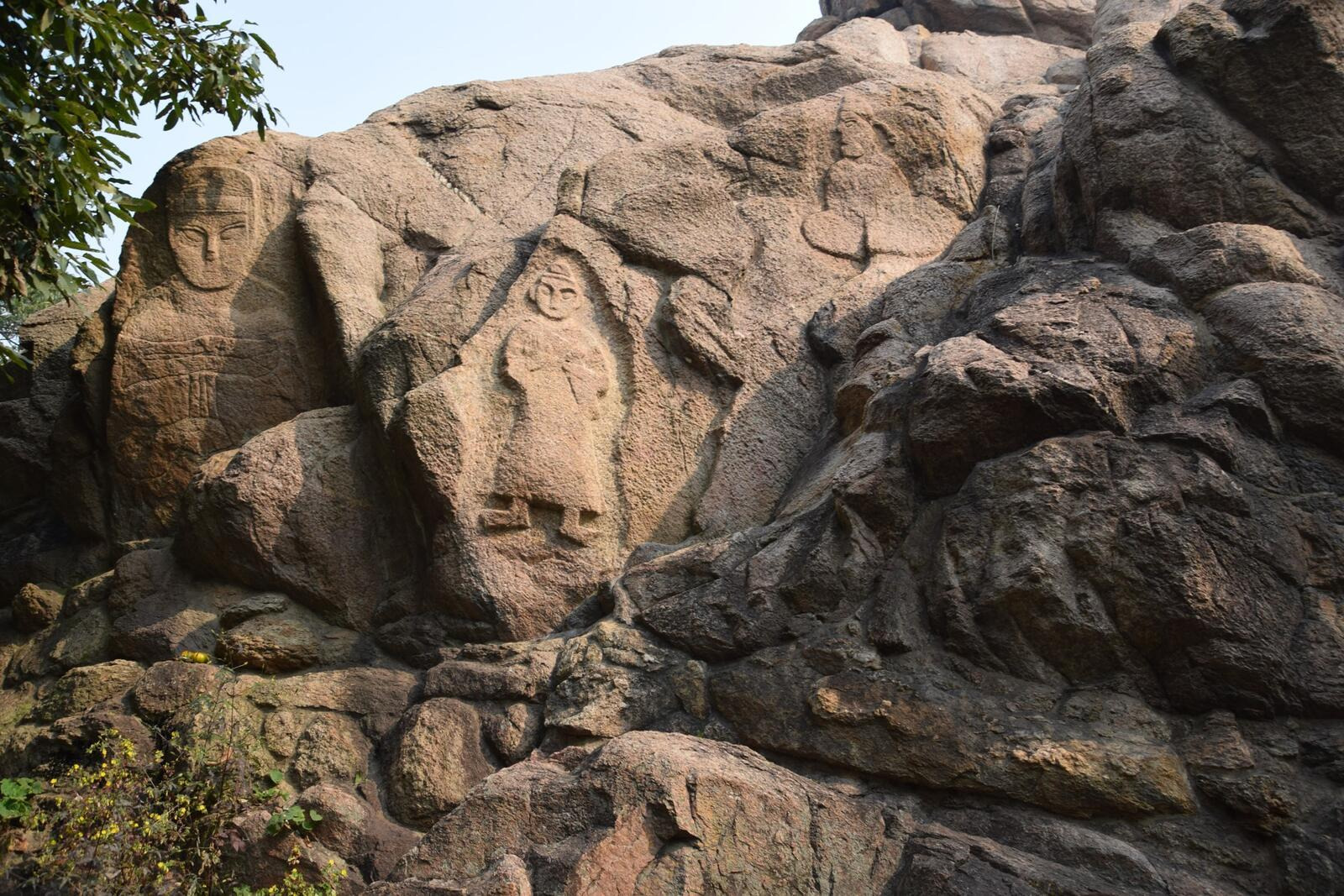
What makes this religious and artistic complex exceptional is not only its antiquity but its syncretism. Carved flat with the linear technique of the Han style, these figures transcend defined religious boundaries. In them, characters with foreign traits (probably Indo-Scythians) meet with secular donors and with Taoist deities such as Xīwângm (the Queen Mother of the West). This mixture indicates that the site was a place for practical cultural exchange, where sacred accumulations had no dogmatic detachment.
This phenomenon, which historians call “doctrinal confusion”, is due to the fact that the images arrived in China long before the sacred texts were translated. Indigenous artisans had to translate foreign iconography into their own systems. The ultimate example is the scene of Parinirvana (death of the Buddha). How was a scene of mourning in Indian art reinterpreted in Kngwàngshān as a banquet of immortals? By ignoring the theology of nirvana, the artists changed the scene at a Taoist holiday celebration, showing that the visual form was taken long before the doctrinal content was understood.
Invisible Art: The Lost Architecture
It's important to notice a painful gap in the archaeological record: architecture and painting. Historical chronicles, such as Houhanshu, describe the founding of the White Horse Temple in Luoyang and mention imperial murals depicting the Buddha after the famous dream of Emperor Ming. However, the perishable nature of Chinese wooden architecture and the fragility of silk have erased these masterpieces. What we have left is an art of “underground survival”: objects made of stone, bronze and fired ceramic, designed to last eternally inside graves. Ironically, we know Han Buddhist art not from what the living saw in their temples, but from what the dead were taken to their graves. There is a discrepancy between the texts and the findings: the chronicles confirm active worship on the surface, but those works have been lost; what has lasted is the trousseau protected underground.
Conclusions: The Buddha as “Great Immortal”
Han archaeological analysis—from rock reliefs to ritual metalwork—shows that the Buddhist presence in China during the 2nd and 3rd centuries was not a phenomenon of doctrinal conversion but a process of magical-symbolic appropriation. The figure of the Buddha, stripped of its original soteriological dimension, was reinterpreted through the cosmological paradigm of Taoism: not as the founder of a philosophical system centered on Anatman (“no-me”), but rather as a Western “Great Immortal” (da xian) whose numinous power was comparable to that of native deities such as Xīwangm.
This phase is a case of religious hybridization where the Buddhadic image, incorporated into the same iconographic substrate as mythical entities and Taoist immortals, underwent a process of effective cultural “domestication”. The Buddhadic iconography present in ritual mirrors and “money trees” did not function as a contemplative support or as a vehicle for understanding nirvana; its purpose was strictly to guarantee, through its exotic magical charge, prosperity and protection both in the earthly and funerary spheres.
This “Buddhism without Dharma” is a phenomenon where formal transfer preceded conceptual assimilation: just as Gandhara's plastic lost its Hellenistic volume to adapt to the two-dimensionality of Han art, Buddhist philosophical sophistication was reduced to fit the cosmological schemes of Chinese civilization.
- Rhie, Marilyn Martin (1999). Early Buddhist Art of China and Central Asia (Vol. 1). Leiden: Brill.
- Wu Hung (1986). “Buddhist Elements in Early Chinese Art (2nd and 3rd Centuries A.D.)”. Artibus Asiae, 47 (3/4), pp. 263-316.
- Zürcher, Erik (2007). The Buddhist Conquest of China: The Spread and Adaptation of Buddhism in Early Medieval China (3rd ed.). Leiden: Brill.


