

This article is part of our special edition ”Buddhist Education in Latin America and Spain”
Buddhist ethics is not limited to a set of rules or a system of external commandments. In its deepest sense, it is born of discernment, inner cultivation and the realization of awakening. This will be the central perspective of the conference that Bhikkhunī Dhammadinnā will give next Wednesday, April 29, 2026, under the title ”A transformative moral phenomenology: the inner and outer dimensions of ethics in early Buddhist teachings”.
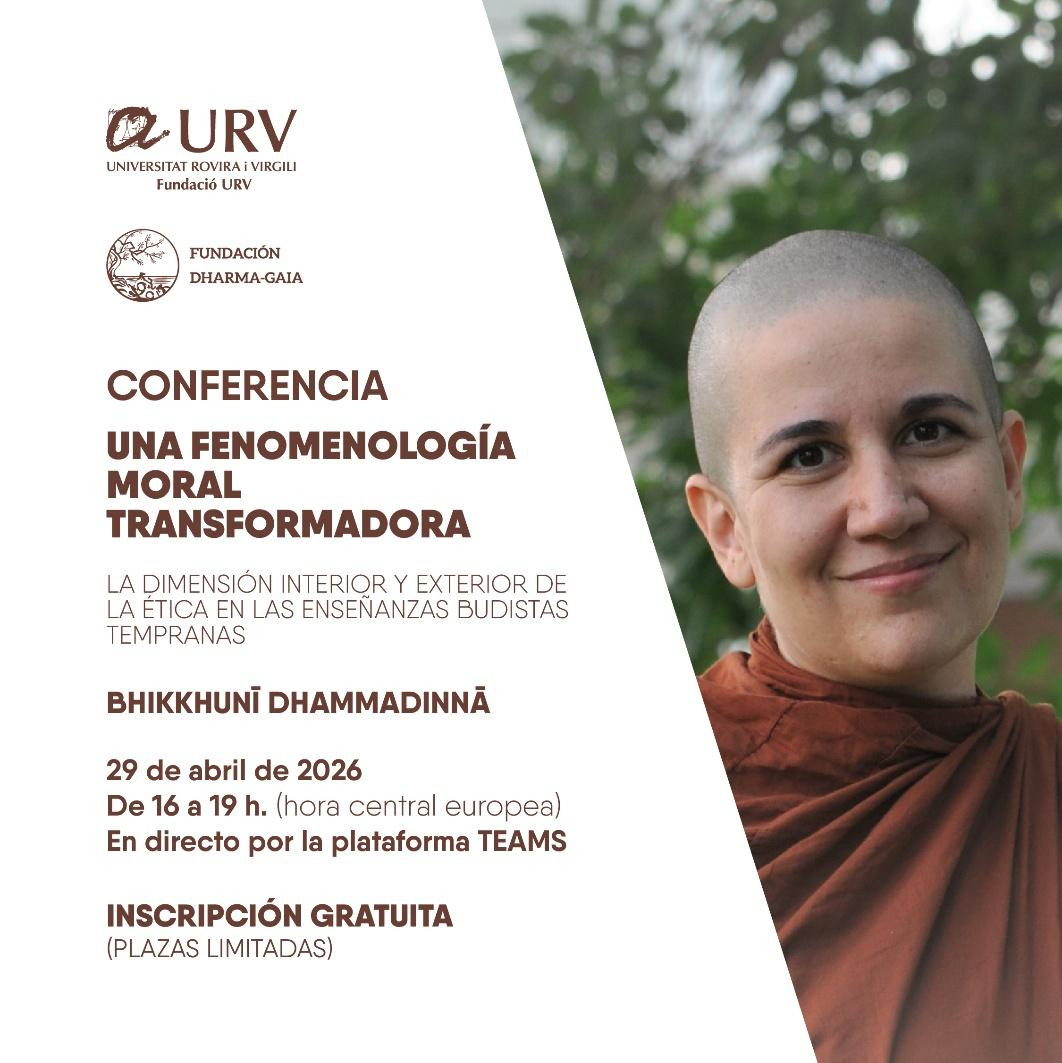
The session will be held from 16:00 to 19:00 (Central European Time) and will be offered live through the Teams platform. With registrations now open, the meeting offers an excellent opportunity for practitioners, researchers and people interested in deepening the relationship between ethical living, mindfulness and transformation of experience within the framework of early Buddhism.
Registration for the conference by Bhikkhunī Dhammadinnā — URV Foundation
An ethic rooted in awakening
The conference will explore how Buddhist ethics are based, from an epistemic and soteriological point of view, on the realization of awakening. The exhibition will focus on the oldest layers of Buddhist texts and teachings, paying attention to both continuities and differences between early and later traditions.
From this perspective, the basis of Buddhist ethics lies in the discernment of what is healthy and what is unhealthy, together with the decision to cultivate what is healthy. This capacity shapes the very possibility of a moral life. Without that fundamental discernment, ethics cannot emerge in a genuine way.
On this basis, Buddhist teachings show a deep interest in a transformative psychology centered on subjective experience. Thus, Buddhist moral discourse can be understood as a form of moral phenomenology, that is, a rigorous attention to the lived dimension of ethical transformation.

The inner and outer life of ethical practice
One of the most suggestive axes of the paper will be the relationship between the practitioner's inner life and its interpersonal and social dimensions. From the Buddhist approach, ethical training does not simply consist of obeying rules, but of being part of an organic inner and outer life, in which subjective transformation and the relationship with others are deeply intertwined.
In this framework, mindfulness takes center stage. Not only does it make an ethical life possible, but it is also sustained by the care dedicated to that same moral life. Ethics and mindfulness nourish each other as inseparable dimensions of the Buddhist path.
The conference thus offers an opportunity to approach a vision of ethics that is neither punitive nor dogmatic, but profoundly transformative. It is an ethic that emerges from self-knowledge, from the cultivation of the mind and from a conscious responsibility in the relationship with the world.
An internationally renowned monastic scholar
Bhikkhunī Dhammadinnā is a monastic scholar specialized in Buddhism and meditation teacher, recognized for her work with textual sources in Pali, Sanskrit, Chinese, Tibetan and Khotanese. His research pays special attention to the impact of historical-textual, soteriological and institutional developments on ideologies, theories and meditative practices.
She is currently director of the Āgama Research Group, visiting associate professor of Buddhist Studies at the Dharma Drum Institute for Liberal Arts (Taiwan) and visiting professor of Buddhist Studies at the University of California, Berkeley.
His academic work is distinguished by building bridges between the critical study of Buddhist sources and the deep understanding of contemplative practice, which makes this conference an especially valuable event both for the university environment and for the community of practice.

Conference Information
These are the main data of the activity:
- Conference: A Transformative Moral Phenomenology: The Inner and Outer Dimensions of Ethics in Early Buddhist Teachings
- Speaker: Bhikkhunī Dhammadinna
- Promoting entity: Rovira i Virgili University Foundation
- Sponsor: Dharma-Gaia Foundation.
- Organizer: Alfonso Schwartz
- Date: Wednesday, April 29, 2026
- Time: 16:00 — 19:00 (Central European Time)
- Modality: Live on Teams
- State: Open registrations
The conference will address Buddhist ethics as a practice of discernment, inner transformation and mindfulness and will offer a unique opportunity to deepen a reading of Buddhist ethics that articulates textual rigor, contemplative sensitivity and contemporary relevance.
An Invitation to Rethink Ethical Living
At a time when many people are looking for ethical frameworks capable of integrating internality, clarity and shared responsibility, this conference is presented as a particularly relevant proposal. His approach allows us to reconsider Buddhist ethics not as a closed code, but as a process of attentive cultivation that involves personal transformation and conscious relationship with others.
Bhikkhunī Dhammadinnā's intervention promises to bring textual depth, conceptual clarity and a valuable contemplative perspective to one of the central themes of Buddhism: how to live ethically from the direct understanding of experience and in line with the path of awakening.
To learn more about the speaker's career, publications and research, you can consult her official website:
https://bhikkhunidhammadinna.com

Useful links:
Faculty of Translation and Interpretation of the Autonomous University of Barcelona
“RIEB — Ibero-American Network for the Study of Buddhism”
Catalan Buddhist Film Festival
Articles published in Buddhistdoor en Español
«La situación de los estudios budistas en España: los programas docentes» by Juan Arnau Navarro, Montse Castellà Olivé, Francisco Díez de Velasco, Ricardo Guerrero Diáñez, Basili Llorca Martínez, Daniel Millet Gil, Agustín Pániker Vilaplana, Aleix Ruiz Falqués, Jaume Vallverdú Vallverdú, Abraham Vélez de Cea.
Inscripciones abiertas para el curso en línea El budismo temprano y la tradición theravāda: enseñanzas y prácticas organizado por la Fundació Universitat Rovira i Virgili y la Fundación Dharma-Gaia Buddhistdoor en Español
«Los estudios budistas en la Argentina». Primera parte: los orígenes» by CATÓN CARINI Y BELÉN AZAROLA.
«La expansión de los estudios budistas mediante el estudio del pali: entrevista con Aleix Ruiz Falqués» by Dipen Barua y Daniel Millet.
Buddhist Studies in Latin America and Spain (Volumes I & II), edited by Daniel Millet Gil and Jaume Vallverdú Vallverdú. Volumes I and II of this work bring together a series of essays that explore the relationship between Buddhism and Spanish-American culture. The first volume addresses issues such as the reception of Buddhism in Latin America and Spain, the translations of Buddhist texts into Spanish and the impact of Buddhism on contemporary societies. For its part, the second volume expands this approach with interdisciplinary and regional analyses on the interaction of Buddhism with local cultural traditions and their impact on the academic environment.
Both volumes are available in PDF format and can be downloaded free of charge through the following links First volume and Second volume


